Tuesday, April 25, 2006

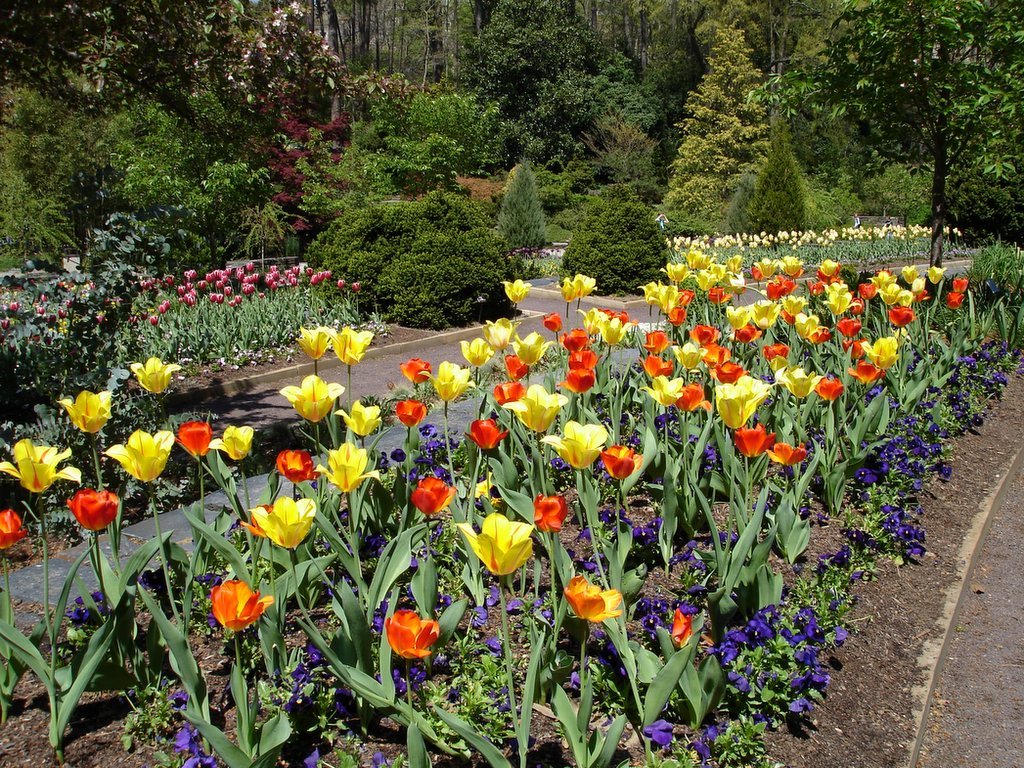
Duke Gardens..


Tulips, Japanese Maple, and a ton of other beautiful flowers and trees. Spring is the season to be in NC! If you can handle the pollen :- Posted by Picasa

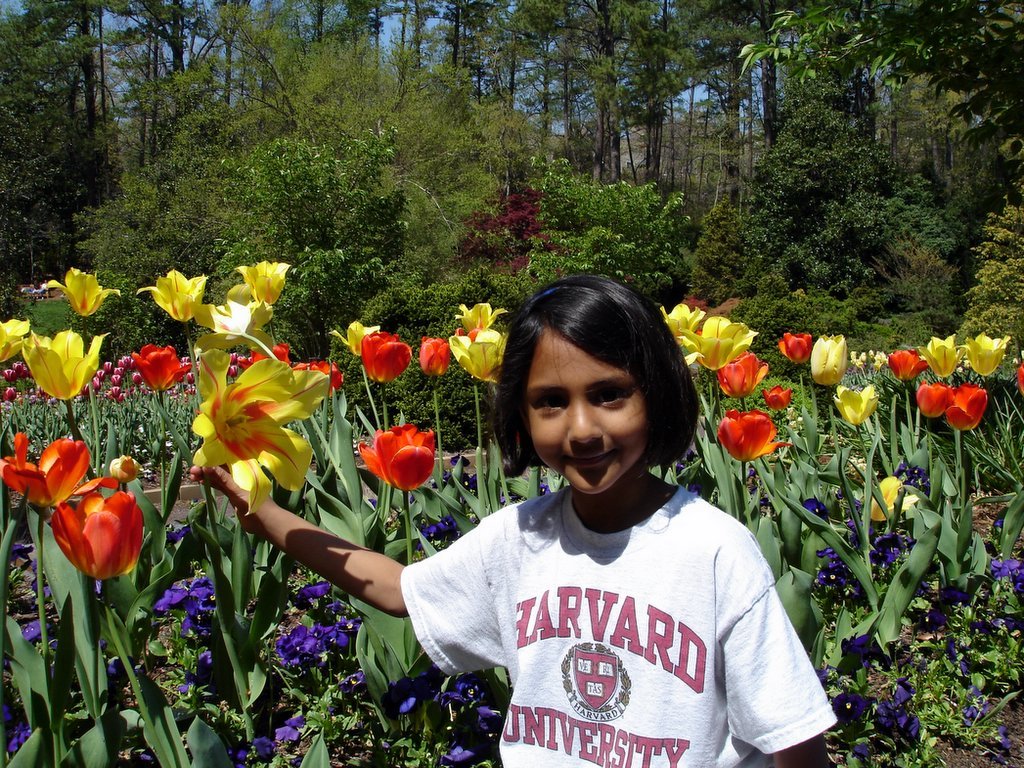
Tanya Posing at Duke Garden.


The flower is almost as big as her face! Duke Gardens, Durham, NC. Unfortunately, Durham is in the news for all the wrong reasons these days. Click on the photo to enlarge.Posted by Picasa

Thursday, April 13, 2006

Google, Yahoo and beyond..

Like a breath of fresh air – they keep coming at you. Un-relentlessly, without any remorse, with simple punches, from the right and left. Keep you wanting for more… and more.. Yes you are right – I am talking about Google. Today they released their calendar. Its so simple and elegant – that the only word that came out of my mouth was ‘wow’.

The world of Google started with – of course, Google. Then they hit us with gmail – and then again with Google talk, Google videos, yada yada. One thing that’s common with all these applications is that they are ALL simple to use – but powerful nonetheless.

The calendar is no different. Here is another suggestion to make it even better. Make use of the ‘tab’ phenomena more. In the calendar, on the left hand side, there are some tabs for news, gmail etc – make them open in the same window – not a new one.

BTW I used the phone out feature from yahoo yesterday – ooooooh.. sweet as honey. At 12 cents to India – it’s the best deal yet from any good company. (Reliance comes up to be about 14.4 cents if you do the math). The quality is great considering its VOIP and the ease of setup etc is virtually .. I’m confusing myself now – I should just say – it was easy to set it up.

I think Skype is history.

One thing I cannot get is that it charges all of 1 cent to Canada, 1.5 cents to Australia – but 2 cents to calls made to a phone in the US! Hmm..

Here’s a prediction. In another 6 months – we are going to see google talk do this VOIP thingy as well – I mean PC to phone (they already do VOIP for their talk program), anyway, so they will come up with their own phone out thing – only difference – it will be of course – FREE. Yup. Let me say that again – you can make a call to a phone from your PC for FREE. How they are going to do this – you will no doubt ask? Well - They would provide a ‘premium’ service where users can pay for a phone call – just like what yahoo is doing it – but they will also have a free service – for cheepos like us. All we would have to do before making a call would be to see (or see and listen to) an ad on our computer for maybe 30 sec or so. I think they will get tons of ads for this kinda stuff – don’t you? You can bypass their ads using their premium service.

So there you go – Google stock jumped another 30 bucks :) . If only I had 10 of those.

Thursday, April 06, 2006

Here & there: India - metros and trains - Razi Azmi

Here is the second in a series of four articles about a Pakistani writer’s trip to India. The original can be seen here.

--------------------------------------------------------

Thursday, March 23, 2006

William Dalrymple recently wrote that one ought to visit Bihar if one wished to see India as a failed state, adding that if one wanted to see how India will look if it succeeds, one should go to Bangalore instead. Perhaps, time will tell

Kolkata has an underground metro train line with 17 stations extending over 16 kilometres. Service is cheap, frequent and punctual. In contrast to the city above them, the underground trains and stations are quite clean. The metro, India’s first, used to evoke pride among the people of Kolkata, but now it is no match for the spick and span, ultra-modern and larger metro system of Delhi.

Metro or not, Kolkata’s decline commenced when the British moved the capital to Delhi in 1912. The partition of Bengal in 1947 (resulting in the separation of East Bengal, now Bangladesh) hastened the decline, which was aggravated by decades of Communist rule.

If there is one thing that can definitely make the Bengalis of Kolkata and West Bengal (and, to a lesser extent, Bangladesh) proud, it is their affinity for literature, dance and drama. Many years ago, a special issue of the Far Eastern Economic Review had commented that only in Kolkata were you likely to meet a police officer who could discuss Shakespeare and Tolstoy.

When I mentioned this to a friend, he confirmed its veracity from his personal experience. After the Bangladesh war of 1971 he had been arrested and taken to the police station chief in a border town of West Bengal for illegally crossing the Bangladesh-India border. On seeing that he was reading a novel by Tolstoy, the chief ordered his immediate release! But the captor didn’t let his prisoner go until the two had exchanged a word or two about Tolstoy.

Kolkata has been made famous by Satyajit Ray, one of the best film directors the world has produced. In 1992, on his deathbed, he was honoured with a Lifetime Achievement Special Oscar.

If their metro train and cultural accomplishments give pride and joy to the people of Kolkata their man-drawn rickshaws are a blight. Not many are left, and they are confined to a small section of the city, but it is a pathetic sight to see a human being, tethered to a two-wheeled rickshaw much like a horse, running on the street pulling passengers seated at the back.

By Indian standards, Kolkata only gets a trickle of Western “backpacker” tourists and most of them arrive only in transit from Bangkok heading for other destinations in India. The many hotels and restaurants in the city thrive on account of visitors from neighbouring Bangladesh — businessmen, tourists and students.

Thousands of Bangladeshi students pursue higher studies in India and many Bangladeshi colleges and universities take their students on “study trips” to India. Kolkata is not only a point of entry into India for Bangladeshis, but it is for Bengalis everywhere what Lahore is to Punjabis. It is their cultural Mecca.

Motorways and roads are being constructed throughout India at a frenetic pace. Their centrepiece is the oddly named Golden Quadrilateral connecting the four so-called mega-cities of Delhi, Mumbai, Kolkata and Chennai.

There are many private airlines operating in India, Jet Airways, Air Sahara, Deccan Air, Spicejet and Kingfisher being the major ones with large fleets of modern planes. The traffic at Delhi airport (India’s second busiest, after Mumbai) is comparable to some Western airports: a steady stream of planes landing and taking off. Thirty-five airlines fly to Delhi. There are over two dozen flights daily between Delhi and Mumbai alone.

Most Indians can’t afford to fly and, owing to the huge distances, trains remain by far the principal mode of long-distance transportation. Given the high demand for railway tickets, buying one usually entails standing in long queues and well in advance of the travel date. Ticketing is fully computerised and tickets may be bought anywhere in India from any point of origin to any destination.

The Indian railway system as a whole is a wonder. It is a massive network, the world’s largest, inherited from the British but hugely expanded and improved in the last 50 years. Single tracks have been turned into double tracks, lines have been electrified and many metre gauge lines have been converted to broad gauge.

The number of trains that run on the tracks is just unbelievable. Excellent long-distance overnight trains named Rajdhani Express connect the national capital with virtually every distant state capital. Comfortable daytime short-haul trains called Shatabdi Express connect the capital with nearer destinations such as Lucknow, Agra, Jaipur, Amritsar and Chandigarh.

Trains may run late, they may be overcrowded, but they run with a frequency and cover distances that are mind-boggling. But derailments and accidents are rather frequent and the human toll is often high. Ignorance and human error are to blame as much as technical failure, ageing equipment and infrastructure problems.

I will be less than frank if I did not tell readers that my first railway journey in India 15 years ago was a disaster. As I was sleeping on an upper birth in an express train from Hyderabad to Chennai, I woke up in shock in the middle of a very dark and wet night about halfway through my journey. A thunderous roar and shaking confirmed my worst fears: my train had derailed.

Slowly but surely my coach overturned and fell on its side. Although a total of eight coaches overturned injuring many passengers, fortunately no one died. I escaped without a scratch and arrived at my destination safe and well, though a bit shaken, about 14 hours late. As reported in the next day’s newspaper, the derailment was caused by “metal fatigue” of the track when the train was travelling at a speed of 80 kilometres per hour.

The accident had occurred at about 2:45am. The relief train arrived nearly three hours later. By then all passengers, some screaming from pain, had been pulled out of the overturned coaches by villagers. When the relief train did arrive, the “rescuers” had little to do except transport the passengers to the nearest station.

Other than this “minor inconvenience”, my experience of the Indian railways has been pleasant. I have travelled from Mumbai to Delhi, Kolkata to Varanasi, Allahabad to Delhi via Lucknow and Jaipur to Delhi via Agra, in addition to Hyderabad-Chennai.

Indeed, a journey on the Indian railway is likely to be an educative experience in multiculturalism, human camaraderie and plain efficiency at a low cost. I must admit, though, that I travelled first class most of the time, with the added privilege of booking my place on the trains through the special facility for foreigners.

Indian trains are India in microcosm, both for better and worse. If the state of the state of Bihar is any guide, the decision to make Laloo Prasad Yadav the minister of railways doesn’t bode well. During the 15 years that Yadav ruled Bihar directly or through his wife and cronies, it descended into violence and lawlessness.

The well-known writer on India, William Dalrymple, recently wrote that one ought to visit Bihar if one wished to see India as a failed state, adding that if one wanted to see how India will look if it succeeds, one should go to Bangalore instead.

Perhaps, time will tell. But the Indian railways are too serious a business to be left in the hands of any politician, let alone one with Yadav’s reputation.

This is the second part of a series of articles. The writer can be contacted at raziazmi@hotmail.com

--------------------------------------

Wednesday, April 05, 2006

Here & there : Incredible India - Razi Azmi

A well written, interesting and very readable account of a trip to India by a journalist from Pakistan.

Here is the first in a series of four articles. Also available here

---------------------------------------------------------------------

Thursday, March 16, 2006

India’s central, state and local governments have not even bothered to clean up the towns that attract tourists, such as Varanasi (Benaras), Jaipur, or even Agra, for that matter. No cleanup or window-dressing for tourists. Take it as it is or leave it. Such is India’s allure that Western tourists keep coming nevertheless, some of them on their second and third visits

The title of this column is borrowed from the buzzword of India’s official campaign to attract more Western tourists to the country. On my first trip to India, 15 years ago, I had visited Hyderabad, Madras (Chennai) and Bangalore in south India, as well as Mumbai (Bombay) in the west. Having just returned from another trip that took me to Kolkata (Calcutta), Uttar Pradesh, Delhi and Rajasthan, in the east, north and west, I have to agree. Incredible India!

India takes one’s breath away, both metaphorically and literally. Metaphorically, because one is simply awestruck by the number and majesty of her monuments, by the size of the country, by its cultural, religious and linguistic diversity, and by the many signs of economic and social progress. India, it seems, has more world-class historical monuments than the rest of the world put together. Speaking of first-rate monuments of Muslim heritage, I wonder if India may not have more of them than the rest of the Muslim world combined.

Stretching from Burma to Pakistan, from Sri Lanka to China, India’s diversity is stupefying. Imagine a Naga alongside a Sikh, a Tamil next to a Kashmiri. With 15 official languages and countless dialects, there is more diversity in India than entire continents can boast.

Although it is a Hindu-majority country, there are as many Muslims in India than in Pakistan or Bangladesh, more Christians than in Australia, as well as millions of Sikhs, Buddhists, Jains, Parsis, animists and others. Predominantly Indo-Aryan in terms of racial origin, a quarter of India’s population is Dravidian and three percent are a mixture of Mongoloid and others. And it’s not mere statistics, India’s diversity is evident everywhere, in colour, cuisine and costume.

India also takes one’s breath away quite literally, for there are streets, lanes and bazaars where one can hardly breathe — so strong is the stench from the strewn, rotting garbage and human and animal excrement. Incredible India!

India’s central, state and local governments have not even bothered to clean up the towns that attract tourists, such as Varanasi (Benaras), Jaipur, or even Agra, for that matter. No cleanup or window-dressing for tourists. Take it as it is or leave it. Such is India’s allure that Western tourists keep coming nevertheless, some of them on their second and third visits. Not the stench, not “Delhi belly”, not even the bomb blasts, nothing will stop them. There is something magical about India. In fact, India is full of magic, superstition and surprises.

If first impressions are last impressions, then I arrived at the wrong place. I flew into Kolkata, which has little to show by way of modern development, except a new bridge across the river Hooghly. Its finest buildings were built during the British Raj, but most are in various stages of decay or disrepair.

Kolkata makes one wonder why the people of West Bengal continue to vote for the Communist Party of India (Marxist), which has delivered little except, possibly, subsidised food and cheap public transport. Enough reason to vote, some might say. Compared to Delhi or Mumbai, not to mention Bangalore, Hyderabad and Chennai, Kolkata seems like another world, in a kind of time warp, forgotten by time — and by the central government in Delhi.

The ride into town from Kolkata airport introduced me to that side of India which Pakistanis would much rather not know about, for they prefer tales of Muslim persecution in that country. The day of my arrival happened to be a public holiday throughout the country on account of Muharram. My taxi driver feared a traffic jam on the main road because of the Muharram tazya procession. And although we took the back streets, we still ran into a smaller procession, complete with chest beating and all.

My first acquaintance with Kolkata’s bureaucracy was a trifle amusing, if a bit frustrating. It was typically Bengali, in terms of the tardiness, as well as the verbosity and sentimentalism on display. At a quarter to ten, I joined a line of mostly Westerners outside the locked doors of the railway reservation office for foreigners. The door opened a few minutes after ten. We were allowed in and made to sit in a waiting hall with numbered forms. The counter was equipped with four computer terminals, but only one of them was operating. Work didn’t commence until a quarter of an hour after opening time.

With just one official at work, progress was slow anyway. But within about twenty minutes, it ground to a near-halt when he got into an acrimonious argument with a colleague in a mixture of Bengali and Hindi. On arrival, the colleague in question had been accused of being a habitual latecomer. As everyone watched, the two exchanged sharp words mixed with irony, with the accused saying that the accuser’s attitude confirmed what he had always suspected, that his life and welfare did not matter to the latter at all, for he had not even cared to ask the reason for his coming late.

I was reminded of the comment of the American journalist, PJ O’Rourke, about his experience in Kolkata in 1998 in his book The CEO of the Sofa: “I spent the next four days trying to accomplish something in India again... This would take twenty minutes. Adjusting the clock to Indian Daylight Wasting Time, that’s four days.”

The people of Kolkata vote for the Communists, but religion and superstition pervade their lives in a way that I have not seen elsewhere. Most taxis in the city are adorned with a miniature deity, or a picture of one, on the dashboard. That, of course, is not much different from the religious verses and incantations that are suspended from the rear-view mirrors of motor vehicles in Pakistan. What was different was that a driver would alternately touch the deity and his forehead two or three times with the fare to bless his income.

On one occasion, I climbed the raised soil around a pipal (fig) tree on the footpath in order to better position myself to take a picture. But before I could take one, I felt a tap on my shoulder. A man had drawn my attention to something where I stood. Quickly, I retreated with an apology, for I had desecrated a sacred tree. I had failed to notice the two or three stones, along with few flowers and some vermilion, signifying something sacred. Every tenth tree or so had the aura of holiness attached to it in this manner.

Later, in another incident that educated me in the social intricacies and religious nuances of India, I slipped my foot into a slipper (chappal), which I intended to buy, to make sure it was the right size. It happened to be on the top of a stack of slippers and miscellaneous footwear for sale on the footpath. Their owner furiously demanded that I withdraw my foot, which, I surmised, had the effect of defiling his stock.

True, his stock consisted of footwear but, until sold, they were his capital, his asset, his means of livelihood, and therefore, clean and sacred, not to be trampled underfoot. Incredible India!

This is the first part of a series of articles. The writer can be contacted at raziazmi@hotmail.com

-------------------------------------------

Friday, March 10, 2006

Indian City Shows Restraint Amid Bombings

--
If anything was to set off the next round of bloodletting between India's Hindus and Muslims, many feared it would be this week's bombings in Hinduism's holiest city.

Twenty people were killed in the attacks, which were blamed on Muslim extremists and targeted a temple and the train station.

"Imagine if the Israelis attacked Mecca, or a Muslim man bombed the Vatican — that is how I, how we all, feel," said Ravneet Sharma before offering prayers at the Sankat Mochan temple.
Yet in the days since, this wounded city of temples and holy men has shown remarkable restraint. The feared retaliation has not come to pass, despite the inflammatory rhetoric of Hindu nationalist leaders.
The calm — if angry — aftermath, many here say, is booming India's modern response to ancient tensions that have long set South Asia's Hindus and Muslims against one another.

"So much pain is coursing through my heart," Sharma said. All around him the devout appealed to the monkey god Hanuman, chanting prayers and rubbing sandalwood paste on statues of the deity. The sound of monkeys running over the roof echoed throughout the building.

He made it clear he feels little love for his Muslim neighbors. "They are not my brothers," he said.
But India is a growing economic and diplomatic power and "these extremists want to destroy our peace and prosperity," he said. "Communal violence is their aim. We must control our impulses."

Instead of rioting, most of Varanasi's million people showed their anger through a general strike that shut down the city on Wednesday.
On Friday, the city's narrow alleyways were once again choked with pushcarts and cars and the Ganges River was coursing with boatmen ferrying pilgrims and tourists. Shopkeepers chewing betel leaves tended display cases of cell phones, cheap electronics and Hindi music.

More than 80 percent of India's 1 billion people are Hindu. Their relations with Muslims, the country's largest religious minority, have been largely peaceful since the partition of the subcontinent at independence from Britain in 1947, when more than 1 million people were killed as overwhelmingly Muslim Pakistan was carved from largely Hindu India.

But there have been periodic bouts of sectarian strife. Thousands died in rioting after Hindu militants tore down northern India's historic Babri Mosque in 1992. A campaign to build a Hindu temple at the site propelled the Hindu nationalist Bharatiya Janata Party to power in 1998.

But it's been two years since the BJP was voted out of national office, and with elections coming up in Uttar Pradesh state, where Varanasi is located, party leaders and other Hindu nationalists are making their presence felt here.

Seemingly endless processions of Hindu nationalists have made their way through Sankat Mochan since the attacks, chanting what sound more like a call to arms than a prayer.
Juel Oram, a BJP politician from the eastern state of Orissa, said the attacks are rooted "in the appeasement of Muslims by the government." Uttar Pradesh is run by a politician who has long championed Muslims and lower-caste Hindus.

Although Oram, like the other Hindu nationalists here, said he opposed violence, he spoke of the need to "crush the Muslim element if we are to solve this problem."
It's words like these that have led to violence in the past.
"Indian people pick up rocks and sticks at the behest of politicians," said Ashok Yadav, a 40-year-old shop owner. He said he was angry, but would "vote," not riot.

The temple's spiritual caretaker, 68-year-old Veer Bhadra Mishra, was blunter — "Wherever there is a carcass, you have vultures circling overhead," he said.
A senior civil servant in Uttar Pradesh who has served throughout India said politicians have riled up emotions in the past.

He cited religious riots in western India in 2002 that human rights groups have long charged were encouraged — and at times directed — by BJP officials.
The official, who requested anonymity because such statements could ruin his career, said after the bombings, authorities deployed hundreds of police to keep mobs from forming.
"Now it's best to let these people burn themselves out," said Alok Sinha, Uttar Pradesh's top home ministry official.

Viva - Varanasi 2


"Build me my ghats, the river, the life as I know it, in the backyard and may be I will stay back" -Ustad Bismillah Khan - turning down an offer of an American connoisseur to stay in the US
- Photo taken December 17th 2003 from the window of our room at the Scindhia Guest House.
 Posted by Picasa

Thursday, March 09, 2006

Viva Varanasi


This photograph is dedicated to the many individuals who perished in the bomb blasts in Varanasi on the 6th of March. What centuries of treacherous foreign rule and lax and lazy Indian administration cannot destroy, cannot be disturbed by a couple of silly homemade bombs. People do not understand the real nature and life of Varanasi. As old as civilization itself – I am not in any position to even try and describe the vivacity of the millions that make this wonderful city, and the city itself.
This photograph was taken on 18th December, 2003 when I really saw the ancient city for the first time. I had visited the city before many times – but had never seen the beauty and depth it carries in its arms. The simplicity of little boys flying kites on roof tops, the thrill and fun at seeing monkeys jumping from building to building demanding taxes in the shape of bananas – as though they run an administration in parallel to the district administration, the aura of aartis on Ganga at dawn and dusk, the goose bumps that I am getting right now thinking about the beauty of it all are feelings that cannot be put to words.

Maybe its time we installed CCTV and start frisking everybody that enters and leaves a public place. Its sad – I know – but the enemy is faceless, coward. We live in dangerous times. Posted by Picasa

Wednesday, March 08, 2006

But you gotta buy by the box


Yup - those are Mangoes!! $6 a box. What was the President talking about when he visited India??
And a whole box of bell peppers for $15 ! Posted by Picasa

Hey - do you want to share some onions?

Have you signed the NPT first?
No..
Then I cannot deal with you.
??
Just kidding - we are not dealing in Uranium here - just some harmless onions and tomatoes - plenty of them. Posted by Picasa

India? Pakistan? Australia? China?


OK - so enough politics for a week - ok 2 weeks.
As promised - here are some photos of our local farmer's market. What could be better than fresh fruits and veggies? What fun :) Posted by Picasa

Tuesday, March 07, 2006

"Let's stop beating around Bush"

Here is a great article about a good reason why what happened in India last week, happened. I'll copy paste the entire piece in entirety.
--

In 2004, top-20 contributors to Bush's election campaign included Citigroup, Bank of America, Microsoft, PricewaterhouseCoopers, Merrill Lynch and Morgan Stanley. In 2005, Citigroup India collected $38 million in fees from Indian companies and is now India's second largest investment banking entity (with 25 offices and branches across 18 Indian cities). Bank of America has Continuum Solutions Pvt. Ltd., its wholly owned subsidiary based in Hyderabad, which processes the Bank's back-office operations (Bank of America has moved hundreds of jobs from the UK to Hyderabad).

Microsoft has just one software development centre outside the US and that is in Hyderabad. Microsoft India has presence in Kolkata, Hyderabad, Pune, Chennai, Bangalore, Mumbai and Gurgoan. In 2002, Microsoft committed $400 million for India. In 2005, $1.7 billion was committed.

PricewaterhouseCoopers has offices in Bangalore, Kolkata, Chennai, Hyderabad, Mumbai, New Delhi, Bhubaneshwar and Pune. DSP Merrill Lynch Limited is now India's largest investment banking entity with offices in New Delhi, Mumbai, Kolkata, Chennai and Bangalore. Morgan Stanley runs India Magnum Fund and India Investment Fund.

Besides the top campaign contributors, Corporate America sees India as a strategic partner. Pepsi, Ford, IBM, Kodak, Coca Cola, Microsoft, Motorola, Heinz, Monsanto, Warner Bros, Federal Express, Bankers Trust, Parke Davis, Intel, JP Morgan, Kellogg, Pfizer, Procter & Gamble, American Int'l Group, Exxon-Mobil, Delta, Boston Consulting, Oracle, Unocal, Xerox, Lockheed, Raytheon, Rockwell, Honeywell, Adobe, AES, Alcoa, American Express, Northrop, McKinsey, Amway, Polaroid, Caterpillar, Dell, Sun, Texas Instruments, NCR, Hewlett Packard, Lucent, Novell, Ingersoll-Rand, American Data, MetLife, Cognizant, Caltex, Tenneco, Covansys and Diebold already have offices in Mumbai, Delhi, Bangalore, Hyderabad and Chennai.

US corporate giants are now dependent on Tata Consultancy, Infosys Technologies, Wipro, Satyam Computer Services, HCL Technologies, Patni Computer Systems, Silverline Technologies, Mahindra, Pentasoft, Mascot, Mascom, Mastek, Polaris, L&T and Hexaware (all Indian software giants). Furthermore, US exports to India were up over 30 per cent last year, making India one of America's fastest growing major export markets.

In Washington, the India Caucus has become a lobby to be reckoned with. Out of a total of 435 representatives elected to the 109th Congress around 120 are official members of the India Caucus (the Congressional Caucus on Pakistan claims to have 55 members of which at least 12 are also members of the India Caucus).

From a geo-strategic standpoint, the Pentagon has already moved China from a 'friendly competitor' to a 'strategic adversary'. And, the Pentagon needs India to counterbalance China; a democratic India which could become an economic as well as a military counterweight to China. An India that will also buy billions of dollars of American weapons systems. Deep down, Indian elite also craves to stand up to China and that India cannot do without American help. In effect, Indo-US relationship is economic, political and strategic.

Then there is the 'Great Game in Central Asia' where Russia and China both long for ending America's 'monopoly in world affairs'. The Russia-China axis is propagating the Shanghai Cooperation Organisation (SCO) as a challenge to America's central Asian strategy. The Moscow-Beijing nexus has brought Iran and Uzbekistan under its tent. America is actively courting India (is it courting or is a wedding in progress?) after having brought Georgia, Ukraine and Azerbaijan under her tent. Where does Pakistan stand in this 'Great Game'?

Islamabad is a mere 425 miles from New Delhi but Pak-US relationship is neither economic nor political. In Islamabad, Bush's top-5 agenda items were terrorism, terrorism, cross-border terrorism, non-proliferation and democracy. America sees Islamabad's misnamed 'Constitution Avenue' sitting on top of several fault lines; a civil-military fault line, a fundamental-moderate fault line and a whole host of ethnic fault lines (all besides the tectonic one). For Bush, Islamabad is all about challenges.

America looks at India and sees economic buoyancy-cum-political stability. America looks at Pakistan and finds neither. America looks at India and sees opportunities. America looks at Pakistan and sees nothing but challenges.

Should I be mad at Bush because Bush does not treat us as India's equal?
--

Friday, March 03, 2006

Oh! the questions I have


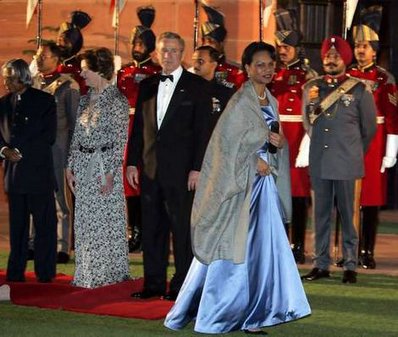
Oh Condi, My Condi,
Thou art beautiful – why art thou not mine,
Even if thou art not mine, that doesn’t mean I can’t have an eyeful.
Like India’s presidential palaces, thou stand tall, and graceful.
Like India’s multitude, thou art colorful and smart.

Oh Condi, My Condi,
Where did thou get that dress?
Did thou have it when we leave our great country?
Or did thou ask Singh to have one sewn for thou.
Why doesn’t the lady next to me wear anything like that – ever?

Oh Condi, My Condi,
The questions I have, can anyone answer?
Oh Condi, My Condi,
Why art thou not mine? Posted by Picasa

What a Shame

What a site it was – Communists and Muslims holding rallies and mass protests – complete with Osama posters and claims that Osama is our leader – and more dear to us than our parents. Who says India does not have al-qaeda. Seems like a claim 5 years ago that said India does not have people with HIV or AIDS.

What were they demonstrating for? Agreed – that the US (and its leaders) have done a plethora of bad stuff around the world – and in their own country as well. So – what should India say – thank you all – we don’t need any power to light our homes and roads and factories? Lord Palmerston, the famous 19th century British Foreign Minister once said, nations have no permanent friends or allies (or permanent enemies). They only have permanent interests.

That is the problem in India. All kinds of people live together. Every kind vying for complete control over the other kinds. No kind wants to give any ground to the other kind. People of 10 different religions, communists, socialists, capitalists, rich, poor eat in the same thaali, each trying to get a larger piece of the chapati, and while one is engaged in breaking of a larger chunk of the bread – the other tries to gobble all the Daal. Then there are also people who are trying to drill a hole in the thaali as well. In the end – some go to sleep with their stomachs bursting – while the others sleep hungry.

Excuse me for this poor analogy – but this is what India is.

But maybe – this is what a bottom up, free society is like. Had Bush been in China – all the protestors would have been locked up 100 days before his visit – and never freed again.

Monday, February 27, 2006

India V China

Every where (most recently, Washington Post, Newsweek and Times Online) you read and listen, people are comparing India and China and the fact that India is a democracy while China is not. Whether the Indian democratic society that is bound by leftist leaders and by a need of having to please a coalition will be able to compete with a more flexible, focused Chinese autocracy that is not hesitant in wiping out everything that comes in its way. Which model do you think would you choose? Which is a better model to have for the long term?

Wednesday, February 22, 2006

May God bless India and Pakistan, and may God continue to bless the United States

Thank God for President Bush. He said these important words today. (Read the last line from http://www.nytimes.com/2006/02/22/international/asia/22cnd-prexy.html )

He requested God to bless India and Pakistan today while requesting Him to continue to bless the United States. He wouldn’t have lost some blessings for the United States if he had simply said “May God continue to bless the United States, India and Pakistan”. But that would have meant that God is already blessing India and Pakistan and hence no need for a special recommendation from the only person on this planet closest to God (as we all know God speaks to him directly and takes important advice from him every now and then). Also – we, the commoners, wouldn’t have a clue as to how much blessings HE has – so maybe He has to be conservative in his blessings.

And so as the president makes a special request on our behalf, all Indians and Pakistanis should bow down and say thank you Mr. President, for you remembered us in your prayers today. May God ALWAYS bless you, continue to bless the United States and bless India and Pakistan every now and then.

Tuesday, February 21, 2006

Our Farmer's Market.

Every Saturdays, apart from the regular habits of getting up late, a relaxed tea in bed and the likes, we have developed a love for our local farmer’s market which is not far from where we live. We make sure we have some cash in out pockets and we head to the large shed where the local farmers display and sell their produce. From a distance of more than a hundred meters, we could make out the hustle bustle inside the place.

After I parked the car this past Saturday, my wife mentioned a strange feeling that she gets – something that I agreed I have too – that of a strange nervousness and a strange excitement. In that large open building (I’ll take my camera the next time we go there) we interact with at least 2 to 3 dozen people, sharing our vegies and fruits, asking for change, asking for bags etc. Its an activity that takes some courage and getting used to if you haven’t done it before.

We get a lot of fresh vegies and at a very nominal price but the best thing of all is the sight of so many people at one place.

Wednesday, February 15, 2006

Valentine's Day!

So what exactly is this Valentine’s Day? Restaurants, Greeting Cards companies (think Hallmark), flower companies (think FTD) make a killing on this day – I read somewhere that it’s the 2nd busiest day for the restaurants (Mother’s Day taking the top spot here). I guess it makes sense to assign days when you think about a certain member of your family. Like a program tells a mechanical robot when to blink, a set program on the calendar tells a materialistic and overly indulged society to stop and take some time out for their loved ones. So we have Mother’s Day, Father’s Day & Valentine’s Day. But wait - what about the poor brothers and sisters? Lets not even think about the grandparents, uncles and aunts.

Of course, being a materialistic society, it would have been blasphemous to leave the money factor out from the equation.

Actually, we discovered it’s a great day to do your groceries and do any other mundane tasks. The stores were practically empty and cashiers cheerful!

What did we do? We got a bottle of red and celebrated at home. In the day, we had a great laugh exchanging emails (me and my brother) about what each of us would write to our wives if we were to write a Valentine’s Day email .

Tuesday, February 14, 2006

Bob Cesca: EXCLUSIVE: First Photo of Cheney Shooting Victim - Yahoo! News

Here is the latest on the Cheney Shooting incident.
I somehow knew that there is something more than what is apparent in this whole incident.

Bob Cesca: EXCLUSIVE: First Photo of Cheney Shooting Victim - Yahoo! News

Saturday, February 11, 2006

Today's Links:

As if enough hasn’t already been said about the cartoons of the Prophet – so I am not going to say much.

For the inquisitive – who have looked on Google and failed – the cartoons can be viewed here:

http://www.brusselsjournal.com/node/698

The Philly Enquirer published one of the cartoons – and gave an explanation here:

http://www.philly.com/mld/philly/13805804.htm

I also found this article of interest.

http://livecurrent.latimes.com/livecurrent/2006/02/kill_the_cartoo.html